“What is Joseph Stalin’s Positive Significance?” / History Teachers’ Questions after the XX Congress
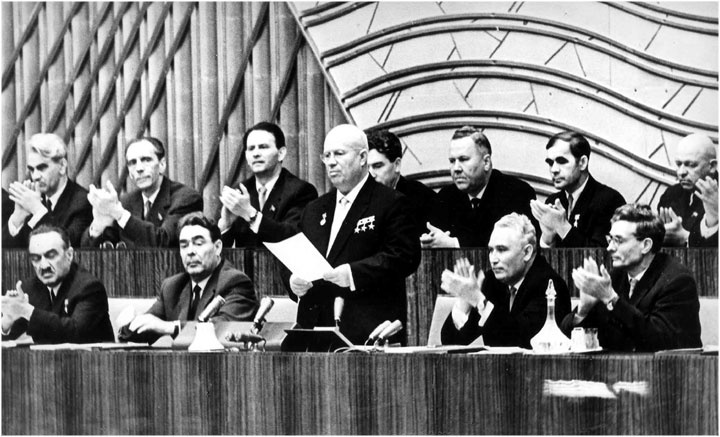
In the Soviet Union, after the XX Party Congress, the doctrine governing historical memory and narratives of the past underwent substantial modification. Anna Pankratova, historian and author of a 1939 school textbook, conducted “outreach” in connection with these changes. In 1956, Pankratova appeared at public lectures for teachers and other “ideological front” workers, commenting on Khrushchev’s denunciation of the personality cult and talking about changes to (and the “tasks” of) historical study and research. But there was much about this new version of the past that her listeners didn’t understand, and audience members bombarded the lecturer with questions (“How do we interpret this…?”). Some of the most striking questions, passed to the lecturer as notes, are included below.
 |
 |
 |
 |
 |
![Comrade Pankratova. From Khrushchev’s report “On the Personality Cult ...” it is clear that Stalin committed a number of criminal and bloody acts. You call him comrade! This means that you share his crimes. So, where is the consistency, adherence to principles and ideology? [Signature is illegible]](http://www.urokiistorii.ru/sites/all/files/image/shkola/zapiski/13.jpg) |
 |
 |
 |
 |
 |
 |
 |
 |
 |
 |
 |
 |
 |
 |
Documents from the archives of Society “Memorial”
“Dear Anna Mikhailovna! Could you please explain…”
Author: Boris Belenkin
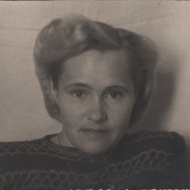
Information: Anna M. Pankratova (1897-1957): historian, academician (1953), member of the CPSU Central Committee (1952-1957), member of the Supreme Soviet of the USSR and the Presidium of the USSR Supreme Council (1954-1957), the chief editor of the journal Voprosy istorii (Questions of History) (1953 -1957). An iconic figure of the Soviet 1920s-50s. She was, on the one hand, a Bolshevik, fanatically loyal to the ideas of Marxism-Leninism, against which there was no greater sin than straying from the party line (she is believed to be the prototype of Korzhavin’s famous “Tan’ka”
Nahum Korzhavin’s poem “Tan’ka” ); a seemingly hard and uncompromising individual. Yet, on the other hand, she is remembered also as a compassionate person, one who could be described as an intercessor or defender. There was hardly anyone in the Central Committee or Supreme Soviet who was as open to assisting others (including prisoners) as PankratovaSee: Istorik i vremia. 20-50-e gody XX veka. A. M. Pankratova [Historian and Time. 1920s-50s. A. M. Pankratova] (Moscow, 2000), 18; L.A. Sidorova, Anna Mikhailovna Pankratova // Istoricheskaia nauka Rossii v XX veke [Anna Mikhailovna Pankratova: Russia’s Historical Science in the Twentieth Century] (Moscow, 1997), 433-44. She helped the repressed earlier, as well, in 1937-38, in spite of the fact that the repressions affected her directly. She was expelled from the party (for one year) and exiled for several years to Saratov, where she still managed to successfully continue her research and teaching activities (see: Istorik i vremia, 165, 212). .
On February 20, 1956, Pankratova, a delegate to the XX Congress, reported on the situation in historical science. After the Congress, Pankratova gave presentations and lectures to a relatively wide audience (academic and creative intellectuals, history professors from universities and schools, professors of Marxism-Leninism, students, party activists, including various “ideological front” workers, archivists…) titled “The XX Party Congress and the Tasks of Historical Science,” in which she discussed the problems of historical science in the next five years. She gave nine talks in Leningrad from March 20 to 23, as well as several more in Moscow over several days in late March and early April. Her talks, however, did not necessarily revolve exclusively around the announced topic. She went far beyond the proposed framework (which was, in itself, rather special) as a consequence of Khrushchev’s famous report “On the Personality Cult and its Consequences.” This report was presented at party meetings, some of which were attended by non-party activists, immediately after the XX Party Congress. As Pankratova wrote in April 1956:
“[N. S. Khrushchev’s – B.B.] report has generated a lot of sensitive issues, but the audience was warned that neither debate, nor questions would be allowed. After the presentation of the report, no “explanatory work” was conducted. All this led to discontent and a great number and variety of questions, which indicated widespread intellectual confusion and extreme emotional excitement.”
Taking responsibility for this very “explanatory work,” Pankratova, during her numerous meetings, faced the first tide of public reaction to Khrushchev’s disclosure of Stalin’s personality cult. In Leningrad alone, Pankratova’s audience reached approximately 6,000 people. And among these attendees, more than 800 people passed notes with questions to the speaker. The Moscow audience was certainly no smaller.
About 130 notes from the audience are held at Memorial’s archive in Moscow. The documents are originals and some of them are dated, which means that they were penned by those who attended Pankratova’s Moscow lectures.
Pankratova handed over additional notes from her Leningrad audience to the Secretary of the Leningrad Regional Committee. A version of the accompanying “memorandum” (the document’s full title is “Memorandum by the Academician of the USSR Academy of Sciences A.M. Pankratova in the CPSU Central Committee on the Outcome of Speeches in Leningrad with Lectures and Presentations on the XX Party Congress and the Topics of Historical Science”) with small author corrections is also available in the archive
- “The Role of Personality”
- “On V. I. Lenin’s Writings”
- “On the CPSU Central Committee,” “On Stalin”
- “On the National Question”
- “On Scholars”
- “On Historical Science”
- “The History of the Soviet Union to 1917”
- “On the History of the USSR and the CPSU”
- “On the Short History Course of the All-Union Communist Party of Bolsheviks”
- “On Teaching History”
- “On Fiction”
These represent examples of an epistolary genre, “notes from the audience.” The existing selection is sufficiently representative that we can use it to draw conclusions, not only about audience members’ thoughts and emotions, but also about readiness (including psychological readiness) for change among the members of a certain segment of Soviet society. This readiness is comparable to what was observed during Gorbachev’s perestroika. Today, when reading these notes, dated March and April 1956, one cannot be help feeling déjà vu. As was the case thirty years later, we see questions, confusion, both the rejection of change and also the desire to go “further, further and further” … Yet, at that time, in 1956, the confusion ran too deep. Thirty years of ongoing revenge on the part of those who opposed change, thirty years of waiting for answers to the many questions addressed to the faithful Marxist-Leninist Anna Mikhailovna Pankratova, still had to pass. Pankratova died from a heart attack exactly a year after her post-Congress lecture tour. This was as a direct reaction to the Central Committee’s devastating criticism of her journal. At that moment, the “perestroika” conducted under her editorship by Questions of History seemed impermissibly bold to party colleagues and bosses. As for those who did not want to wait … that’s another story (including the history of dissent in the USSR, the history of the dissident movement, the history of resistance to the regime, the history before and after Solzhenitsyn’s Gulag Archipelago …).
Here, we offer the reader a small selection of notes from the Memorial archive:

1.
Why does the bourgeoisie have two or more parties, which serve them to the best of their abilities, while the working class of the Soviet Union may have only one party?
Perhaps the presence of a second party for the working class would protect the country from many ills?
2.
Comrade Pankratova!
1) How can one explain why revolution from above was needed in 1929 to eliminate the kulaks as a class? Maybe an agrarian program, similar to the one other countries are realizing now, could have been employed.
2) What errors appear in coverage of this topic: The Great Patriotic War of the Soviet People Against Fascism.
3) Does Stalin’s assessment of NEP remain intact, or are there any amendments?
3.
Dear Comrade Pankratova!
1. You mentioned that Stalin made one mistake with the national question.
Please enumerate other erroneous statements or articles written by Stalin during Lenin’s lifetime, but later concealed from the party.
2. Who participated in writing the Short Course?
4.
Will the works of such party figures who worked with Lenin but made errors and biases (Bukharin, Rykov and others) be available for examination?
Studying Lenin deeply, it is apparently necessary to be very familiar with his opponents.
5.
Please answer a few questions.
1. I would like to learn from a Marxist historian, along with certain facts, the analysis of the causes (economic and political) of the creation of the “personality cult.”
What were the causes and the conditions?
Have they ceased to be in effect now?
2. Do you think that conditions for objective, Marxist coverage of the history of the Soviet period have already been established, or will we be witnessing the birth of the next official version of historical events?
3. Pardon my frankness.
Where is the guarantee that the leaders of historical science, who preached anti-historical concepts for a long time, and sometimes simply falsified history (the facts are in your report), will be able to stick firmly to Marxist positions on history.
The old burden is still felt.
6.
Comrade Pankratova!
We are now studying the XX Congress, but we cannot find materials on how much pig iron, steel, coal, etc. is produced per year in the USA, the UK, and other capitalist countries, as well as how much is produced in these countries per head, and how much is produced in the USSR.
Where is it possible to find these materials?
Please, help.
7.
Some correspondence students, who read the report of Khrushchev at the XX Congress, have written in their essays:
1. Stalin was called Dzhugashvili. One correspondence student called Stalingrad “Tsaritsyn.”
How would you respond to such statements?
8.
Will Lenin’s final testament be published, and will it be published in full?
9.
How can one interpret the Non-Aggression pact of 1939?
10.
How should one interpret the Baltic countries’ connection to the Soviet Union?
Students often ask about it, because there is no reasonable exposition in the textbook.
11.
You are talking about the necessity of reporting historical events as objectively as possible. How, then, can we understand the principle partisanship as it relates to the study of History? Starchenko
12.
Comrade Pankratova!
Please, tell me, having reviewed Engels’ correct instructions, who is to blame for the justification Tsarist foreign policy, Tarle or Stalin?
13.
What is the current assessment of the Mountaineers movement led by Shamil?
[Mikhaylov]
14.
What changes should be made in material on the history of the Civil War included in the Short Course and the 10th grade textbook on the history of the USSR? How can we understand what is said on this subject in Khrushchev’s report?
At the same time in the newspaper Pravda, the Stalin’s merits in the Civil War are mentioned. How can we teach this issue, and how can we examine it?
15.
Comrade Pankratova!
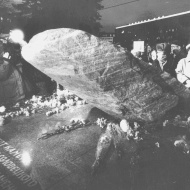
Why was the Monument of Freedom (the Obelisk of the First Constitution) removed from Soviet Square and where is it now?
16.
Is there any certainty that Vladimir Ilyich died as a result of a disease?
17.
We know that communism can only be built by people who don’t have any property.
The leaders of our society have the highest wages, summer cottages, apartments and townhouses. Their property thus exceeds that of the lesser bourgeoisie and the bourgeoisie itself. A fear of losing of such “personal” property therefore gives rise to the development of a personality cult. When will our country’s teachers be raised to the height that Lenin spoke of?
18.
Comrade Pankratova!
Please, tell me how to assess the annexations of lands with non-Russian populations (throughout history) as progressive or as non-progressive and predatory. What is progressive and non-progressive in this case.
Tell me about subjective and objective sides of the case.
Teacher from School 241
[Signature is illegible]
19.
1. In the program and in the new textbook, will there still be questions such as: “Stalin’s oath,” “Stalin on the need for further strengthening the Soviet state and on the state under communism”?
2. Studying the topic of the Great Patriotic War, how could Nazis’ temporary successes be explained? The issue of a surprise attack, indeed, disappears. In general, how can one address the question of the country’s preparedness for war?
20.
Dear Anna Mikhailovna!
We ask you to explain how and to what extent we are able to use transcripts of party congresses, recollections of the old Bolsheviks, and other literature withdrawn earlier. How could we know that one of the former figures has been reinstated? Is it possible to speed up the 3rd edition of the Short Historical Bibliography on the History of the USSR!
21.
Comrade Pankratova!
Please answer: how can one characterize and assess what is known about the so-called “enemies of the people”? Because the students are not waiting, they are asking questions, especially adult students at evening colleges, among which there are many people with life experience, communists, etc.
How can one explain if the famous accusations about the intention to dismember our country, transfer it to Japan, England, etc., that were presented and, so to speak, legislated in relation to Trotskyites, Bukharinites, Rykovites etc., are right. Who is guilty and who is not guilty of these crimes.
22.
What are the class roots of such a widespread movement as the personality cult?
23.
Could you say how Lenin’s documents on which Stalin wrote, “do not print,” “premature” etc. will be used.
I have seen these documents.
24.
Comrade Pankratova, what explains the objective limitation of some of the rights of national minorities, in granting senior positions, in selection for postgraduate courses, etc.?
25.
What are the origins of the personality cult in the USSR from the perspective of Soviet historical science?What will be the fate of Stalin’s works? They are no longer present in plans for seminars, in the recommended literature (IAS [Institute for Advanced Studies – B.B.]).
What is the situation with the use of archival materials at the present time and what prospects are there for the future?
26.
Has the personality cult impacted our country’s economic, political, and governmental systems?
How?
27.
Dear Anna Mikhailovna!
Please, explain the following: if for decades J. V. Stalin ruled by despotic means, and if the basic norms of Soviet law and humanity were violated, what kind of democracy could have existed in our country at that time?
28.
Dear Anna Mikhailovna!
I ask you, as a member of the Central Committee to respond to the question of anti-Semitism, which has now come up, since this issue is more complex than many others, because students know about it not from textbooks, but from ugly street practice and family conversations. Why did the CC not openly question this shameful relic of the personality cult?
29.
In the textbook for the 9th form there are many quotations from the writings of I.V. Stalin. Which of them should be used and which should not.
30.
Dear Anna Mikhailovna!
Tell us, please, what we, teachers of ML’s [Marxism-Leninism’s – B.B.] foundations, will do after September 1956?
Second: How should one think about the works of J.V. Stalin, is it possible to cite any of Stalin’s propositions? Does all that we have just heard not indicate that we will gradually “bury” Stalin once and for all?
Third: How should one explain the role of Trotsky in the period of the Civil War, or should we remain silent about it?
[Signature is illegible]
31.
1) Why did the XX Congress of the CPSU hold elections for the central administration before the report on the personality cult?
2) Why did the Congress not discuss the question of the personality cult and why did it not take a decision on this matter, instead of confining itself to a report?
3/27/56 Kondratiev
32.
What is the positive significance of Stalin’s actions?
33.
Comrade Pankratova!
You talked about Stalin’s merits in the theoretical development of the national question.
But you did not say anything about how Stalin abused Leninism in practice, fighting against entire populations (Kalmyks, Chechens, Jews, Crimean Tatars, and others). This should be addressed in order to properly orient people.
34.
Anna Mikhailovna!
Why, while speaking about the “endeavor” of the struggle against cosmopolitanism, did you not say anything about distortions that have been admitted concerning the Jews?
35.
Comrade Pankratova!
Please, be courageous at least now and call a spade a spade. You should say that cosmopolitanism has turned into anti-Semitism. If you wobble again, you will never be respected.
36.
How could the contradiction, which, in my opinion, is present in a Comrade Khrushchev’s well-known report, be explained.
On the one hand, the report states that Stalin, committing a series of terrible mistakes, was convinced that he was strengthening the party and country.
On the other hand, it is said that Stalin, intending to remove some of the old Bolsheviks from the broadened Presidium, tried to “cover his tracks.”
Should one think that Stalin knew what he was doing or that he was mistaken?
37.
Comrade Pankratova!
Please, tell me whether the policy of the elimination of the kulaks as a class was a historical necessity?
38.
Comrade Pankratova.
From Khrushchev’s report “On the Personality Cult …” it is clear that Stalin committed a number of criminal and bloody acts. You call him comrade! This means that you share his crimes. So, where is the consistency, adherence to principles and ideology?
[Signature is illegible]
39.
Comrade Pankratova!
What caused the historical mistakes that appeared in the history textbook part III under your editorship?This refers to the tenth grade history textbook, the first edition of which was published in 1939. Three parts of this textbook under Pankratova’s editorship (for the 8th, 9th and 10th grades, the authors are A.M. Pankratova, K.V. Bazilevich, S.V. Bakhrushin, A. Foht) survived 22 editions. Why did it feature so few excerpts from Lenin, and more of Stalin?
40.
1) How should we answer students’ question about who the Chairman of the Council of People’s Commissars was after Lenin?
Wouldn’t it be right to not conceal, but to discuss, for example, Rykov and his deeds in the past and his later opportunistic mistakes?
Is it right to scratch a number of names out of history, leaving strange gaps?
Is not it better to give an objective assessment, to show the achievements, mistakes, and harm done by specific individuals? It is necessary to clarify this issue.
41.
In part III of the History of the USSR textbook there is a lot of talk about the mistakes of Trotsky, Bukharin, about their treacherous proposals, plans, etc.
But there is no material explaining why they had been in the party for so long, why they were not excluded.
Students are literally attacking with questions such as, “Did Lenin not realize that they were enemies?” Why were they tolerated?
Vasilieva
42.
Your answer to the question about the Trotskyists is not clear.
From Khrushchev’s report at the ХХ Party Congress, it follows that the Trotskyites and the Bukharinites fought against the party line on issues of building socialism in the USSR, but they were not the agents of imperialism. I got the impression that the materials on espionage for the 1937 trial were obtained means unworthy of the Soviet courts and that these materials are untrue.
April 3, 1956 [signature is illegible]
43.
Comrade Pankratova,
Bearing in mind the circumstances under which the most prominent figures of our party were destroyed (Kossior, Postyshev, Rudzutaks, Eiche, Voznesensky, and many others), as well as the methods of investigation used by our investigative bodies, could one still think that Trotsky and Bukharin and their supporters were the enemies of the Soviet people (were spies, sought to restore capitalism etc.)?
3/27/56. P. Stepankov
44.
Can we consider the Trotskyites, the Bukharinites, and other deviationists to be just ideological enemies of the Party’s general line, rather than spies, saboteurs, direct agents of foreign intelligence services? From N.S. Khrushchev’s report it follows that they were only ideological opponents.
45.
A.M. is it right to consider the ideological intraparty struggle in our country’s period of industrialization and collectivization to be a subversive activity by a group of people specifically aiming at the elimination of the Soviet system?
46.
А.М.!
1) It is said: Stalin did a lot of useful things. But Bukharin and Trotsky also did useful things. How should they be evaluated? Who caused more harm?
2) Is it true that there is a directive for the abolition of anti-Semitism?
[Written in capital letters, without signature]
P.S. Our selection of the “notes from the audience” is not organized by topic (as, for example, Pankratova herself arranged them). Although, in this “disorderly publication,” we have made one exception by grouping the “Trotskyist theme” at the end. We made this decision in the memory of Anna Mikhaylovna, to emphasize the depth of her personal tragedy. Becoming an ardent supporter (and conductor) of that period’s “Khrushchevian perestroika,” she had not only to break with Stalinist dogma, and not only to recognize her own and others’ theoretical and other “historiosophic” mistakes. She subordinated not only her career as a scholar to the strict canons of ideology. She also subordinated her private life to this cause. For the sake of “the Party’s course,” she rejected the only man she loved, the father of her child. She laid out her terms before him: if he affected a complete break with the Trotskyite opposition, they could be together again; after total disarmament before the party, he could be in correspondence (from exile) with his young daughter … But what now? With just a simple note from the audience, anyone could cast doubt upon not only her scientific work, but also the incredibly difficult decision—or maybe it was just a tough decision—to put the public (as now follows from the new general line, which was very wrong in certain things) before the private … Yet, a we noted above, she had to suffer such painful questions for only a short time, for only a little over a year. And only in the afterlife (in which neither she, always faithful to the Party line, a convinced atheist, nor he, another convinced atheist who never renounced his Trotskyite opposition, believed) might they now, perhaps, agree on something.
Until her death, Anna Mikhailovna Pankratova remained in the dark about the last days, and, perhaps, last years of the life of her former common-law husband, Grigory Yakovlevich Yakovin. He was one of the initiators and leaders of the strike in Vorkuta (1936-37)—the largest mass protest in the northern camps before the war—and was killed a year later during the so-called “Kashketin shootings”
Published: Newspaper, October 30, № 61, 2006
Additional materials:
- Boris Belenkin, ““Tan’ka! Tanechka! Tanya!..”: Notes on Nahum Korzhavin’s poem and the Biography of Anna Mikhailovna Pankratova,” Scepsis.