Historical Policy in April 2011: Analytical Review
The report for April 2011 is the first one in the series of monthly publications based on the materials of the monitoring of historical policy of International Memorial. The main objective of the monthly report is to single out basic trends in the discussions around history in the public space, enumerate the most important commemoration events of the month, emphasize historical references in the speeches of politicians and public figures, note the reaction of the authorities and the society to “memorable dates” occurring during this period and eventually highlight some general key points – detect priority topics, instruments of preservation/construction of memory about the past and as far as possible define their place and role in the modern historical policy of Russia.
April 2011 was marked by a lot of news in the field of historical policy (the monitoring registered 83 news items compared to the average monthly number of 70-75 news items). A lot of material in April is not accidental – this year a few most important historical and political events of various kinds occurred this month:
- First responses to the suggestions to the program “On immortalization of the memory of the victims of totalitarian regime and on national reconciliation” published by the Presidential Council for the development of civil society and human rights (21 March) (http://www.president-sovet.ru/structure/group_5/materials/proposals_at_a_meeting_in_ekb/index.php), almost at once called “program of De-Stalinization” in mass media (which is formally not very accurate, but obviously reflects the essence of the program in public opinion) and actively discussed in this form throughout the month.
- Preparation for the celebration of 66th anniversary of the victory in the Great Patriotic War - a flaring up discussion on the necessity or, on the contrary, impossibility of using the image of supreme commander Stalin as a symbol of the Victory, as well as more mundane news on the preparation for the holiday: various memorable events for veterans, provision of veterans with new benefits and one-time payments, new plans associated with the commemoration of one of the most important historical holidays for the present-day Russia – 9 May.
- The main “memorable dates” of April: 50th anniversary of Gagarin's cosmic flight, 25th anniversary of the breakdown at Chernobyl atomic station and 141th anniversary of Lenin's birth.
-
“The event of the month”
The given and the following analytical reports will distinguish a unique single event having taken place during this month as “the event of the month”. – - on 1 April Vassily Kononov, participant of the WW II, NKVD officer charged in 1998 by Latvian authorities with the murder of 9 civilians during the war, died. Russian party, considering Kononov's case before and after his death as a “political” issue, publicly expressed regret in connection with his death and also announced it was ready to continue fighting for “his good name” at the European Court.
The sources of news were websites of political parties, newswires on web portals and online versions of the media (newspapers, radio and TV channels) including the regional websites of nongovernmental organizations
The main topic of the month: discussions related to the “De-Stalinization” program
In February 2011 The Presidential Human Rights Council prepared and submitted to the RF President the program “On immortalization of the memory of the victims of totalitarian regime and on national reconciliation”. The debate around this program is in the foreground of the April news of the monitoring at least because the topic of the suggestions and comments to these suggestions imply numerous acute problems of the present-day vision of “the history” and “historical memory” (the role of Lenin, Stalin, “the cost of victory” in the World War II, repressions during Stalin's rule, as well as during earlier and later periods, etc.). The basic points of the program were published in the monitoring at the end of March (http://urokiistorii.ru/1766) – the greater part of news-commentaries (more than a dozen) fell on April already.
Despite the fact that the key topics tackled in the program are formulated quite distinctly (the matter concerns crimes of the Soviet authorities dating back to different years, mostly Stalinist crimes; the necessity of understanding the most tragic periods in the national history of the XX century and overcoming of totalitarian heritage in the present-day Russia), public debate around them often starts with the substitution of notions – i.e. the “suggestions” which do not make part of the document are actively criticized (see article by Yan Rachinsky: “Joseph and his brothers. Remake. Media battles around the De-Stalinization program”: http://www.novayagazeta.ru/data/2011/071/10.html).
One of the most consistent critics of the program is the Regnum agency (formally “informational, but in practice to a large extent subjective and analytical)
- “De-Stalinization program” — manifestation of deviant behavior
- ”De-Stalinization” leads to a civil war
- “De-Stalinization” is a provocation aimed at the destruction of the society
- Russian historical masochism is dangerous for Ukraine
- De-Stalinization of Russia is fraught with a catastrophe
- “De-Stalinization” affecting veterans of the Great Patriotic War
- Russians in Estonia: «De-Stalinization” will avert compatriots from the Kremlin
- “De-Stalinization” idea is akin to a miscarriage
- “De-Stalinization” — ideological terror campaign
- The consequences of “De-Stalinization” will be pecuniary and territorial claims to Russia
- Russophobia and “De-Stalinization” make a pair
- “Desalinizers” are going to sink Russia in an ever-lasting inferiority complex
– this list is far from being complete.
The arguments of the opponents of the program (or of the way they interpret the program) can be briefly summarized as follows: as a result of its realization the difference between “totalitarian” Stalin's Russia and Hitler's Germany will be blurred out, Russia will lose its moral right to be proud of its victory in the WW II, a large-scale polarization of society will occur, possible measures on condemnation of Stalin's ideology and those responsible for repressions will lead to the violation of rights and freedoms of the present-day Communist party and its supporters, etc.
Obviously biased nature of the news of the Regnum agency can be explained to some extent by the fact that “supporters of this program <…> regard all the suggestions as absolutely natural, if not trivial. There is nothing new or revolutionary in them” (see Ian Rachinsky: http://www.novayagazeta.ru/data/2011/071/10.html), hence the share of opinions in favor of the program is not great – and correspondingly the program sinks in criticism from the outside from the very beginning. Another possible explanation is a close link and dependence of the present-day Russian authorities on the system of views on the state and society most severely criticized in the suggestions of the Presidential Council (see in more detail at: http://urokiistorii.ru/2206, chapter on Stalin).
A conspicuous place in the monitoring news is taken by comments to the program by the members of the Pesidential Council themselves – both loyal ones (one of the authors of the text Sergey Karaganov reflects on its basic objectives (http://urokiistorii.ru/1678)), and extremely negative (publicist Alexey Pushkov, also a member of the Council, tells about his disagreement with the ideas of the program (http://urokiistorii.ru/1683)). A separate news item is devoted to a visiting session of the Presidential Council, where the ideological contents of the program was discussed in detail one more time (http://urokiistorii.ru/1711).
A lot of commentaries to the program are of a “vague” character – the speaker does not openly argue with its ideas, however, for this or that reason sees it as “untimely”, senseless in difficult political conditions and sometimes unacceptable because the present-day Russian authorities do not deserve to be the carriers of such liberal ideas (various aspects of these opinions are commented on by member of the “Yabloko” party Nikolay Kavkazsky (http://urokiistorii.ru/1689) and independent deputy of the Kaliningrad Municipal Duma Solomon Ginsburg (http://urokiistorii.ru/1692)).
In the middle of the month Scientific and research center “Memorial” in St. Petersburg organized a round table on the prospects of the state De-Stalinization (http://urokiistorii.ru/1676), where the question on the possible role of the state and the civil society in its realization was discussed. The participants stated that the present suggestions to the program were a “third wave of De-Stalinization”, after Khruschev's thaw and Gorbachev's perestroika.
Thus the program of the Presidential Council is included in a wide historical context and the April debate is but a prologue to further disputes of the spring and summer 2011.
Memorable dates of the month: 9 May is approaching, 22 April — 141th Lenin's anniversary, 26 April – 25th anniversary of Chernobyl breakdown, 12 April – 50th anniversary of Gagarin's flight
Many of the “eternal” historical topics annually recurring in the public discourse on the eve of the celebration of 9 May obtain a new implication in 2011 after the publication of the suggestions of the Presidential Council.
Just like the year before heated discussions on the necessity of appearance of Stalin as one of the symbols of the victory in the war have resumed again. However, if a year ago the battlefield was Moscow, where the mayor Yuri Luzhkov suggested setting up banners with the images of the generalissimo, this year the matter concerned a number of cities (the first information about it appeared in March), where buses and trolleys painted with Stalin's portraits were to drive around (http://urokiistorii.ru/1669).
The project was to appear a private one – the collection of donations from private individuals who were ready to invest their own money was organized, i.e. budget or administrative resources were not involved. Thus the topical political element was “deleted” from the problem.
Official authorities admitted that despite the ambiguity of the initiative with “Stalinobuses” there were no legal grounds to forbid them (http://urokiistorii.ru/1636). However, at the end of the month it became known that the advertising agency in Moscow with which the order for painting the images had been placed, gave it up considering the project to be “political advertising” (http://urokiistorii.ru/1631). Nevertheless “Stalinist” jitneys appeared later in Omsk, and in St. Petersburg the leader's supporters installed a commemorative plaque on the building where he used to live.
The second “Stalinist” issue is the appeal of a group of writers and public figures to the “Eksmo” publishing house with a demand to stop publishing “pro-Stalinist “ literature (http://urokiistorii.ru/1674). As a result of the discussion the parties shared the common vision of the fact that while Stalinism as an ideology is not publicly banned in Russia, any prohibition of similar books would be a violation of the freedom of speech (http://urokiistorii.ru/1643).
Preparation to 9 May was accompanied by a traditional set of events aimed at reminding the society of the grandeur of the USSR victory in the war: erection of monuments (http://urokiistorii.ru/1660), “education of patriots” (http://urokiistorii.ru/1681), start of handing out St.George ribbons (http://urokiistorii.ru/1632). The other pole was represented by a few private initiatives destined to bring “the human dimension” back to this memorable date, with the project “Memory wall” consisting of photos of soldiers at the front standing out (http://urokiistorii.ru/1665).
***
V.I. Lenin's 141st anniversary (http://urokiistorii.ru/1646) gave rise to another and already a traditional discussion on whether it's necessary to carry out his body from the Mausoleum. As in winter, when on the day of Lenin's death the party “United Russia” launched the voting (http://urokiistorii.ru/1937) on the web site goodbyelenin.ru, representatives of the party in power on the whole supported their own initiative on Lenin's burial. They published a digest of the politicians' and public figures' opinions on this question (http://urokiistorii.ru/1644), at that the floor was given, among others, to famous human rights defenders Arseniy Roginsky and Svetlana Gannushkina – whose mere names it was hard to imagine on the news web site of the “United Russia” before.
On 22 April a retrospective of movies about Lenin destined to show the evolution of his image in Soviet and post-Soviet culture opened in the Cinema museum (http://urokiistorii.ru/1641).
However, as in all similar cases for the last years and decades, the opinion that “it's not the time yet” to bury the leader prevailed in the long run, and Lenin remained undisturbed.
***
25th anniversary of Chernobyl breakdown is a rare example for Russian historical policy of state recall of an obviously negative, tragic page in the history connected with mistakes and felonious negligence of the representatives of the authorities
***
The main ceremonies related to the 50th anniversary of the first cosmic flight of a man naturally fell on April (we can even assume that this topic partially “overlapped” with the flow of negative recollections caused by Chernobyl anniversary).
Gagarin's image in a wide public conscience is obviously based on exclusively positive and heroic idea of the success of the national science and the deed of a person – the role of the state in the festive rhetoric is in the background. The place of Gagarin's landing is turned into a “cultural property site” (http://urokiistorii.ru/1672), competitions of children's drawings are organized on the topic of his flight (http://urokiistorii.ru/1702). Gagarin is one of doubtless heroes of the old and new Russia, his flight is everybody's pride.
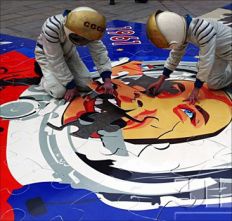
The only scandalous moment in numerous festivities was the protest of communists, who announced that the letters “USSR” had been deleted from Gagarin's helmet on his images reproduced all over the country. In response representatives of the authorities and “United Russia” explained there was no special falsification – the letters were not there originally (http://urokiistorii.ru/1673).
Event of the month: Vassily Kononov's death. Reaction of official authorities
Vassily Kononov is a Latvian citizen, former NKVD officer charged in 1998 by Latvian authorities with the murder of 9 unarmed civilians, one pregnant woman among them, during the war. As of the moment of death European Court of Human Rights was considering Kononov's application on illegality of the charges brought against him and the sentence delivered. Kononov's death gave rise to a wide response of the Russian authorities. The RF President, the Prime-Minister and the mayor of Moscow expressed their condolences (http://urokiistorii.ru/1668) – an extremely rare case. Kononov himself interpreted the case against him in the following way: “Latvia has attacked the sacred. They want to expand opportunities for re-writing the war history. Want to make the winners criminals. Want to put an end to the thaw in the relations between Latvia and the RF and make the gap between Russian and Latvian people even bigger. And they want to rehabilitate Nazism. I believe in my victory. I can already see it” (http://urokiistorii.ru/1668).
Kononov's case became a symbolic and important one for Russian authorties, since from their point of view it could be characterized as “a review of the Nuremberg trial” — which is for the present-day Russian historical policy is equal to a grave crime (i.e. a logical continuation of this point would be “belittling of the role of USSR/Russia in the victory over fascism” (see document “Russian historical policy: Peculiarities of the use of historical resource in the activity of “United Russia” and CPRF” http://urokiistorii.ru/2206, chapter about the Great Patriotic War)).
A week after Kononov's death representatives of the “OUR” youth movement (“NASHI”) together with the Latvian party “Our choice” announced collection of funds for the monument to Kononov (http://urokiistorii.ru/1690). «The matter concerns the future and how we will be perceived in the whole world. We should act in a tough and uncompromising way. I suggest collecting funds for a monument to Vassily Kononov, I am sure, it will produce quite an effect. This monument should be a symbol of justice and impossibility of rehabilitation of fascism” (http://urokiistorii.ru/1690), – the “United Russia” deputy in the State Duma Robert Shlegel said.
April news: special cases
«Hunger strike in the fight for memory»
In the town of Essentuki 83-year-old pensioner Vassily Glukhov came to the building of the municipal administration and went on a hunger strike demanding immortalization of the memory of Cossacks taking part in the WW I.
«A “calendar for optimists” will be published in Moscow – there will be no “bad” historical dates in it»
The draft of the calendar, “in which only optimistic dates and holidays connected with the history of our country will be marked” will come out by 12 June, the Independence Day of Russia. The initiator of the project is the Association of Moscow communities, whose head Vladimir Zotov also heads Moscow Municipal Commission for counteracting the falsification of history.
«A different Moscow: well-known designers came up with alternative posters timed with memorable dates»
The campaign was organized by the “Big city” (“Bolshoi gorod”) magazine, which published the results at: http://www.bg.ru/article/8736/. The reason for the campaign were 5 new dates in the register of memorable dates demanding the hanging of posters and banners.
Thematic index of news items in April
- «De-Stalinization». 7 new items: http://urokiistorii.ru/1678, http://urokiistorii.ru/1683, http://urokiistorii.ru/1689, http://urokiistorii.ru/1694, http://urokiistorii.ru/1692, http://urokiistorii.ru/1711, http://urokiistorii.ru/1676
- Preparation for 9 May, veterans of the Great Patriotic War, regular memorial events. 13 news items: http://urokiistorii.ru/1682, http://urokiistorii.ru/1685, http://urokiistorii.ru/1696, http://urokiistorii.ru/1708, http://urokiistorii.ru/1707, http://urokiistorii.ru/1710, http://urokiistorii.ru/1664, http://urokiistorii.ru/1665, http://urokiistorii.ru/1662, http://urokiistorii.ru/1642, http://urokiistorii.ru/1639, http://urokiistorii.ru/1634, http://urokiistorii.ru/1632
- Chernobyl 25th anniversary. 4 news items: http://urokiistorii.ru/1660, http://urokiistorii.ru/1637, http://urokiistorii.ru/1640, http://urokiistorii.ru/1633
- World War II. 1 news item: http://urokiistorii.ru/1705
- Textbooks. 2 news items: http://urokiistorii.ru/1666, http://urokiistorii.ru/1686
- V. Kononov's death, public response. 2 news items: http://urokiistorii.ru/1668, http://urokiistorii.ru/1690
- Estonia, the “Bronze soldier”. 1 news item: http://urokiistorii.ru/1677
- Regional history. 9 news items: http://urokiistorii.ru/1675, http://urokiistorii.ru/1681, http://urokiistorii.ru/1679, http://urokiistorii.ru/1684, http://urokiistorii.ru/1701, http://urokiistorii.ru/1712, http://urokiistorii.ru/1661, http://urokiistorii.ru/1645, http://urokiistorii.ru/1638
- Gagarin. 5 news items: http://urokiistorii.ru/1672, http://urokiistorii.ru/1691, http://urokiistorii.ru/1702, http://urokiistorii.ru/1673, http://urokiistorii.ru/1657
- Stalin. 9 news items: http://urokiistorii.ru/1674, http://urokiistorii.ru/1669, http://urokiistorii.ru/1671, http://urokiistorii.ru/1650, http://urokiistorii.ru/1651, http://urokiistorii.ru/1643, http://urokiistorii.ru/1636, http://urokiistorii.ru/1629, http://urokiistorii.ru/1631
- Alexander II. 1 news item: http://urokiistorii.ru/1670
- Lomonosov. 1 news item: http://urokiistorii.ru/1663
- Sakharov. 1 news item: http://urokiistorii.ru/1699
- Lenin. 6 news items: http://urokiistorii.ru/1653, http://urokiistorii.ru/1649, http://urokiistorii.ru/1652, http://urokiistorii.ru/1646, http://urokiistorii.ru/1641, http://urokiistorii.ru/1644
- Anniversary of the 1812 Patriotic War. 3 news items: http://urokiistorii.ru/1687, http://urokiistorii.ru/1656, http://urokiistorii.ru/1657
- Holocaust. 3 news items: http://urokiistorii.ru/1680, http://urokiistorii.ru/1697, http://urokiistorii.ru/1709
- History of Ancient Rus'. 3 news items: http://urokiistorii.ru/1688, http://urokiistorii.ru/1667, http://urokiistorii.ru/1647
- History of repressions in the USSR. 5 news items: http://urokiistorii.ru/1695, http://urokiistorii.ru/1693, http://urokiistorii.ru/1706, http://urokiistorii.ru/1654, http://urokiistorii.ru/1648
- Katyn'. 2 news items: http://urokiistorii.ru/1704, http://urokiistorii.ru/1698
- 1990-s. 1 news item: http://urokiistorii.ru/1703
- History of the USSR. 2 news items: http://urokiistorii.ru/1659, http://urokiistorii.ru/1635
- New memorable dates. 3 news items: http://urokiistorii.ru/1658, http://urokiistorii.ru/1700, http://urokiistorii.ru/1655
Prepared by Sergey Bondarenko
Translated by Ekaterina Kokorina