Jan Rachinsky. How the Past is Remembered in Russia: The Topography of Terror and Books of Memory
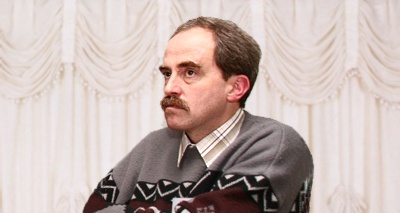
Jan Rachinsky, historian and representative of the human rights society Memorial, discusses the characteristics of the Russian culture of remembrance: much has been accomplished (Books of Memory of the Victims of Political Repression), but even more remains to be done (the Topography of Terror project).
THE TOPOGRAPHY OF TERROR
Information. Memorial began work on the Topography of Terror in the 1980s, yet the project took shape only during the last few years. The idea of ‘binding’ the history of repression to specific locations has unified the research conducted in connection with this project, much like the famous Topographie des Terrors project in Germany.
This project’s first major outcome was Shot in Moscow, a list of those repressed in Moscow, organized by the home addresses of the victims of repression.
Work is also being done on the atlas Moscow: Topography of Terror, which will plot the activities of Soviet penal institutions on a map of the city.
Germany has a great deal of experience studying the history of terror. Could this be of use to Russia?
There are two sides to the study of terror, two possible methods. One focuses on remembrance of the victims, while the other focuses on the locations where it took place. In Germany they pay attention to both sides. Apart from well-known and long-established memorial sites (for example, at the locations of former concentration camps), there are also museums of terror in Berlin itself, in buildings formerly occupied by the Gestapo. On the other hand, there are also the stumbling blocks embedded in the pavement. These are very impressive and I would like it if we eventually had something like this in Russia.
 People who walk past these many times might not even think about them. But those who encounter them the first time pay attention and immediately remember those to whom they are dedicated. This is, undoubtedly, a brilliant invention. It’s hard to say whether this could be adapted to our circumstances. In front of some buildings, we would have to replace the entire sidewalk with these stones: 2 Serafimovich Street, Basmannaya Street. (Between 1937 and 1952, 37 people who lived at 4 Novaya Basmanaya St. were shot, as well as 27 people from number 10, and 17 people from number 14 on the same street. In Moscow there are six buildings, from which even more people were taken than from 4 Novaya Bassmanaya St., and which, like number 14, were under the authority of the People’s Commissariat of Transportation (NKPS).) There is also the building on the corner of Dolgorukovskaya Street. There are more than a few buildings like this. Perhaps it should be done, but up to now, no one has even begun to talk about it.
Aside from problems stemming from the scale of the terror (242 people were taken from one building on Serafimovich St.), it seems that there could also be considerable complications penetrating the urban space. Do you think that the government would find it difficult to permit the installation of the some monuments or memorial plaques?
Such talk puts the cart before the horse. There weren’t any complications with the memorial plaque for Grigory Romanov, the former Leningrad party secretary [details available here and here – History Lessons]. It was recently installed on Leontyevsky Lane. And he is a person, to put it lightly, who does not deserve to be remembered kindly. Quite the opposite. The problem is not whether they will permit something, but whether it is ideologically alien to them.
To a large extent we still live under Soviet power; that era’s dogmas and views are still with us. All of it lives on in language, in terminology. Even if a person comes, through reflection, to understand the Soviet regime’s criminality, all of its horrors, still the clichés find support on the level of language, they continue to live, using old views to prop themselves up.
So this is not so much a question of “penetrating the urban space,” but a question about the fact that officials have not yet begun to embrace these ideas.
This is a problem, then, of ideology, not bureaucracy?
For the most part, yes. It is a problem of ideological attitudes. When they needed to, they created Solzhenitsyn Street, even in violation of the law. And Stanislavsky Street. I’m certainly not talking about some Kadyrov Street. I already mentioned Romanov, and there have been repeated attempts to install a memorial plaque dedicated to General Grigorenko, either on the building of the Joint Staff Academy where he taught, or on the building where he lived, and each attempt has met silent refusal. And this problem did not originate in the bureaucracy.
Nevertheless, a topography of terror project is underway in Russia. And it is the case that without the government’s approval, places in the city that are connected to the history of terror cannot be labeled. What, then, is the project’s aim? Is it limited to gathering material in the hope that the situation in society will change and it will once more appear necessary to attend to these issues?
There is, I think, no single, unified aim here. It is not as much a complete project, as an idea; people direct their thoughts and ideas at it. Really, in order to create something like what already exists in Berlin, we must have support. Germany, moreover, has a completely different cultural context.
To create something without large-scale support from the government here is, of course, impossible, since there are no legal conditions for philanthropy (and stumbling blocks, for example, depend on sponsorship), not to mention oversight and monitoring to ensure that no one donates money where they shouldn’t. The example of Khodorkovsky is the most glaring, but it is by far and away not the only one. There are extremely broad possibilities for the government to influence business. All of this is, certainly, the case.
But, in my view, it is also a problem that our narratives of repression have been worn out. Until 1917, the popular attitude toward prisoners was generally sympathetic. This tradition was not just Christian, it was universal. It represented sympathy for people who ended up in difficult situations, and it arose almost spontaneously. ‘High’ literature aside, there were many simpler publications that dealt with these themes, descriptions of hard labor and the like. Now the situation is completely different. This sort of literature, if it exists, is distinguished first of all by a criminal aesthetic, it’s unattractive and scarcely worth reading. And society is now more likely to avoid such material. There’s neither demand for it, nor is there generally any sympathy for the prisoners. More often, it’s the opposite: “they should have been locked up for longer,” “we need to increase prison sentences,” “serves them right,” “should’ve put him away,” and so on. And this, it seems to me, is in many ways a legacy of the Soviet period.
One of the most important tasks ahead is the ‘allocation of information’. How the penitentiary system existed and functioned until 1917, how it changed after the revolution, what its mechanisms were. The information, even if it is somewhat accessible, has not been handled properly. For example, many Moscow monasteries were turned into prison camps after 1917; even the church doesn’t have information about this. Something has been published, they write about the Novospassky and Andronikov monasteries, they write about Ivanovsky, but few know that the Rozhdestvensky and Pokrovsky monasteries (later the Semenovsky prison camp) were also employed in this capacity. You could theoretically fish these things out of the archives, but the work has not yet been done. [See L. A. Golovkova's article for a discussion of the topography of terror with a special emphasis on monasteries.] So that is the first goal, to gather information and make it accessible. To clarify what happened and where it happened.
There are even bigger gaps in the study of how mass deportations. This demands a new description, not just one that is fragmentary and artistic, like Solzhenitsyn's, for example.
Of course, it is also important that information be tied to concrete places. Taganskaya Prison in Moscow was torn down relatively recently, yet already 99% of Muscovites couldn’t say where it used to stand.
 In the final analysis, the main thing is to bring these questions back to the public in the form of a discussion. People shouldn’t turn their backs on this subject, it touched millions of people in the past, and today the justice system is a long way from working flawlessly.
Several social initiatives have focused on 23 Nikolskaya Street, also known as the . What is happening with this building today? And why was it that, when there was an initiative to create a museum there in the 1990s, that the project was not completed?
 There are a few undercurrents here. I can’t say that I am certain, since almost all of the information is fragmentary. From the very beginning we’ve known that this the Military Board of the Supreme Court occupied this building. A massive number of execution orders were signed on the backs of Military Board orders, on forms bearing precisely that address. At the end of the 1980s, the first resolution of the Memorial conference was, “we hold that this object should become a museum.” This was, if memory serves me, in 1989, when Yevgeny Yevtushenko and Lev Razgon, who were members of Memorial’s Social Council, had managed to gain access the building. [Lev Razgon writes about the building of the Military Board of the Supreme Court in his book True Stories – History Lessons.] Also, it was around this same time that the City of Moscow Cultural Heritage Committee came to control research into the building. They determined that, after the War Commissariat left (at that time the building housed the War Commissariat), “it would be proper to create a museum on the premises, in connection with the building’s use in the 1930s.” But this was just an expert’s conclusion. Nevertheless, it came up again later, and the local government in Moscow included the building it in the plan to rebuild the Kitay-gorod neighborhood. That document sets out, among other things, the necessity of creating a museum at 23 Nikolskaya. Unfortunately, we have no way of determining today who initiated this, since the archive of the local Moscow government is closed to researchers. How this formulation emerged, we can only guess. It is possible that it was simply for mercenary reasons.
Finally, the building on Nikolskaya was repurposed and sold to the Bank of Moscow, and as far as I know, it’s now on its third owner. It was sold quietly, no information about the sale was published.
We tuned in again when the house appeared to be under threat. We received information thanks to Rustam Rakhmatullin from Arkhnadzor, who has, for a number of years, written a column for Izvestiia that is dedicated to Moscow’s architectural heritage. As a matter of fact, he raised the alarm about there being plans to tear down this building. I saw the project; they planned to tear down the house and build something out of glass, from some fanciful plan. This was in 2005. Then, fortunately, there were still many people living in the city who were the children of those shot in the building. We explained to them what was being planned and, as far as I know, hundreds of letters of protest have since been addressed to the mayor. The mayor didn’t want to deal with it, so he kicked it down to the City of Moscow Cultural Heritage Committee. And, fortunately, they unanimously decided that the building should be protected as a historical monument.
Since then, things have been in flux. Most recently, a commission under mayor Vladimir Resin recommended that the building’s status be reduced from that of a memorial to that of “valuable urban construction.” This status doesn’t mean anything—it’s just a word game. That term doesn’t exist in law. And the most it can guarantee is that a building over five stories tall will not be built on the site.
To a large extent the question hinges on the fact that the current owner definitely wants to tear down the oldest part of the building, the part that adjoins Theatre Thoroughfare. This is where evidence of a 17th century construction was discovered, which is natural, since it was basically on the ‘outskirts’. The part that faces Nikolskaya was rebuilt more than once – it was the front of the building – while the section adjoining the Kitay-gorod wall has changed little. It’s most likely that the old part belonged to the Khovansky princes. Once again, the situation has become very uncertain.
What tactics could be employed to defend the building today? Has anything changed in the last five years?
As before, letters are essential, all the more now, with the Stalin lists, which include many well-known names. Among the children of those who were shot, we can count scores of artists who enjoy Russia-wide fame – Plisetskaya, Aroseva, Zbruev, and many others. This certainly plays a role, and not an unimportant one.
But it seems to me that central issue, something that has been underappreciated, is that Russia suffered from repressions no less than the other republics in the USSR. In Ukraine there is a government-wide program, and museums, and memorial complexes in memory of the victims of repression. There is a museum in Malinovka in Kazakhstan, in every region books are published, and just recently Nazarbaev spoke to a gathering concerned with the memory of the repressed. In Uzbekistan (not the most democratic country, to be blunt) there is a museum in memory of the victims of repression, there is a fund, all of this is happening.
In the outside world, people seem to be under the impression that Russia was really such a terrible occupier and everyone was destroyed while Russia lived happily, or they think we all don’t give a damn about our ancestors. Turning the building at 23 Nikolskaya into a museum would be a basic display of civilization, of some kind of respect for history itself. It would demonstrate the value of the past, and not only in words. It’s time to wake up. And the means are the same as before: publicity, attracting as much attention as possible.
BOOKS OF MEMORY
Information. Lists of the victims of political repression in the USSR began to appear in Russian newspapers in 1988-89. Books of Memory later began to be published in many regions. These volumes include biographical information for those who suffered under mass terror during the Soviet period. The Memorial website includes an index to the Books of Memory published to date, as well as general information about the Books.
Books of Memory are being published throughout the former USSR, on a region-by-region basis. Why does the situation vary so greatly from one region to another, with some places producing larger, higher quality books than others? Could we use the Books of Memory to judge the “culture of memory” in these regions?
The situation with the Books of Memory is really quite different wherever you look. In Ukraine, for example, the publication of 56 volumes is wrapping up and they are already creating a consolidated personal database. Right now, people are really focusing on personal criminal records connected to the former criminal code. Books about dekulakization and deportation have yet to be written.
For us, unfortunately, the situation is different. First of all, there are no clear governmental guidelines. In ten regions not a single Book of Memory has been published. It varies throughout the regions. Samara holds the record with 23 volumes. There are regions where just one volume has been published.
 There is also a fundamental difference in quality. The Ivanovsky Region book is the worst, in my opinion. It doesn’t tell us anything. It lists only the last name, first name, and patronymic for each person, and that’s it. Was a person shot or was he detained for a month? It’s not clear. The book was created just for the sake of accountability. At the other end of the spectrum is the Lipetsky Region book. The descriptions are short, but they tell you what happened to someone.
Motivations can differ in the extreme. Activists from the FSB did most of the work publishing the Books of Memory for the Tosmk and Kaluga regions. In other regions public prosecutors took the reins, as was the case in the Ulianovsk Region. Since the FSB was not inclined to cooperate, the regional prosecutor put out a ruling on the extraction of materials from the national security archive. These documents clarified a number of things, for example, that the bodies of the executed were buried on the prison grounds. There were many documents that were not in other books.
We have only a vague understanding of the connection between the government’s ‘politics of history’ and the Books of Memory. It simply isn’t in the forefront the any leader’s mind right now. As a rule, it’s not happening through any conscious influence. It’s simply that someone decided, “It should be done.” Society. Activists. To preserve the memory of their parents. In Stavropol the government was not the most democratic but, nevertheless, an association for the victims of repression was able to conduct its business.
These books start to do their work later on. They spread one way or another. They are in libraries. You can find information on the Memorial website. And for people who find familiar names, or even familiar places, this creates an emotional connection. It makes them think.
The case of the Book of Memory in Belarus offers a good example of the fact that all of these publications are a not consciously and directly connected to the ‘politics of memory’. In Belarus the lists of the repressed are simply included in a more general local history collection, part of the Memory series. It turned out very well. There is a collection for every region, from the distant past to the Civil War, the Great Patriotic War, and the repressions. Now every schoolchild learns about this in his social studies class. Without any special book, in a general context. I doubt that comrade Lukashenko thought all of this up. Judging by his speeches, he’s indifferent to this issue. But that’s how everything is set up. And it works. And it shows the importance of these books, their existence, and their consolidation.
There are huge problems with consolidation, to put it simply. The Soviet authorities relocated huge groups of people, willing and unwilling. There are very few families in Russia that have stayed in the same place for 100 years. This means that it is very difficult to learn about the fate of your relatives, if you don’t find them in a regional book of memory. A consolidated list would help.
How is the creation of Books of Memory going elsewhere, and who is taking part? Probably local authorities, state security organs, sometimes the Russian Orthodox Church, and some local social initiatives. Who else?
There is also the public prosecutor, of course. Public prosecutors in several regions have released pretty good books. In addition to the Ulianovsk Region book, The Seaside Memorial, a very good three-volume collection published in the Archangelsk region.
In all, there are three basic groups involved.
Information Bearers. First, there are those who hold the information, the FSB, MVD, and the public prosecutor’s office. The public prosecutor can call up files from the FSB and the MVD. He not only can, but should. When it comes to criminal repressions, the public prosecutor is the primary actor and should review all of the files related to the articles in the criminal code, just as a matter of course. That’s the function of the public prosecutor’s office.
Then we come to the question of whether they want that this work (which, according to the law, should be done) to appear in Books of Memory. Their task is to review all of the files and decide whether to rehabilitate or not to rehabilitate each person. The law is very indistinct regarding the necessity of publishing the lists of the rehabilitated as part of the review process. It doesn’t say who should do this, it doesn’t describe the form in which the lists should be published. In other words, everything remains completely unresolved, and this is one of the problems we’re facing.
For everyone else, access to information is very difficult. Those who possess the information are accommodating the church to some extent. On the one hand, this is good. At least someone is making concessions. But on the other hand, it raises a question: why accommodate the church alone? I understand, of course, a very large percentage of priests were shot or imprisoned, but these actions were related to categories, national and social, as well. It is unclear why the representatives of different groups are never granted the same access. To make this question broader, it is not clear on what basis these files are closed to researchers. References to personal secrets are completely illegitimate. There are no personal secrets there. Even in prerevolutionary times legal procedure was an open process. At the very least, the bill of particulars, the sentence, the terms of rehabilitation should be accessible without satisfying any additional conditions. Nevertheless, the question of access to information is very important for us, because the very holders of information often become a vital link in the creation of a Book of Memory.
Activists. Next, we have the activists. There are two kinds of activists. First, there are voluntary group activists. The Orthodox Church sometimes plays this role, but its representatives do not always take up the task of creating Books of Memory. Also, within this milieu there are different views on the role of Stalin in our history. Today, finally, some relatively clear positions on this matter have been laid out, but unfortunately, not by the patriarch. Nevertheless, the position of the church has become more clear-cut, which is pleasing.
There is also another breed of social organization. These are, as a rule, associations of the repressed and branches of Memorial—organizations that focus on this issue constantly—but there are also other activists, as well. Ivan Georgievich Dzhukha works on this topic, preparing the Greek Martyrology. There is also someone in Petersburg studying the Ingermanlanders. There are different activists. Someone wrote a book about the repression of railway workers, another person wrote about a specific factory. In other words, the ‘movers’ are the people who feel the need to act. The public prosecutor’s office, which should, according to the law, focus on this topic, sometimes does, sometimes doesn’t, but the ‘movers’ aren’t beholden to anyone. They believe that the Books of memory are necessary for one reason or another.
The Authorities. And third, there are the authorities. A lot depends on them, especially in terms of finances. There are exceptions, as in Tula, where the publication of three volumes was funded in part by membership dues paid to Memorial, and in part by sponsors. The authorities did not participate. In Ulianovsk, where the public prosecutor could not get funding from the leadership for the publication of a second volume, a private sponsor stepped up. But, as a rule, the money for publication must be found in city or regional budgets. That isn’t always easy.
 Sometimes it happens that the authorities themselves—city or regional—initiate the project. The most striking example is in the Komi Republic, where there is a republic-based program for the perpetuation of the memory of the victims of repression. The Repentance collection was published as part of this program. These are large-format, encyclopedic publications. We count nine volumes, but there are, I think, already a dozen separate books. And yet, such examples, to be honest, are very few.
Aleksandr Borzenko,
Sergei Bondarenko
Translated by Adrianne Jacobs