Russian Historical Policy: How United Russia and CPRF Use History as a Resource
Overview
Historical policy implies, by definition, that different political views will compete; but it requires the existence of a democratic society where the State does not have monopoly on history
This paper reviews various public actions toward history by two largest Russian parties represented in the State Duma, i.e. the United Russia (UR) and the Communist Party of the Russian Federation (CPRF), with 313 and 57 seats, respectively
Our paper will not focus on the means of pursuing the historical policy (these are often the public opinion manipulation techniques). Instead, we will focus on the image of the past and the historical resource which the parties employ.
To date (as at July 19, 2011), monitoring of historical policy which International Memorial has been conducting since October 2010 includes 584 news items. UR is referred to in 50 of them, and CPRF in 53. Reference to a party in a news item does not mean that it is an actor or direct initiator of the event which is described in this news item but it always means that the party is involved in the given context.
UR and CPRF are absolute leaders of our monitoring in terms of number of references. While members of the ruling party are often covered in the news indirectly, “against their will” – simply because many parliamentarians, governors and ministers belong to this party, — CPRF seems to be the most proactive player on the history field, it frequently initiates in-memoriam rallies and speeches, signs protest letters, takes part in discussions, etc.
It seems it would be more productive to discuss the historical policies of both parties against each other instead of looking at them separately. This will help to discern nuances in their statements on topics of history that often seem to be no more than routine ceremonial actions related to one or another anniversary.
A set of history topics to which both parties refer will be the basis for comparison, such as the Great Patriotic War, Katyn, Stalin (including “De-Stalinization and repressions), heroes of the soviet past, Yeltsin and the 1990ies, the war of 1812 and a few others. In some cases it would be reasonable to look closely at the problematic and political context of debates, particularly in cases when the parties clash on certain issues or comment on each other’s “historical” initiatives consecutively one after the other.
This study is based on a limited number of materials. Its primary purpose is to draw attention to the materials that have been collected and are open to various interpretations.
1. Introductory Remarks
Historical policy of UR and CPRF alike is targeted at the 20th century.
It would make sense to speak about “history” while speaking about a party or public movement by taking the time of their origination for the “starting point of the modern period.” This is because all preceding events might be absorbed by this party’s understanding of history but have no direct involvement in its activities. Any subsequent event will have to be viewed through the party’s attitude and through evaluation of its activities, so its interpretation is even more biased than memory about the past in general. In the new Russia, CPRF became the oldest party de facto because they are successors to VKP(b) and CPSU. No wonder that the CPRF’s attitude to the Russian history of the 20th century depends on the assessment (invariably positive) of the communist party’s activities throughout this period – certainly not the activities of “internal opposition,” Trotskyites or true Leninists from Ryutin’s group but the mainstream course of the CPSU, i.e. the one maintained by Stalin and Brezhnev.
While CPRF has historical connections with the CPSU, the United Russia can be compared with the CPSU along many lines, given its actual current role. Most importantly, UR and CPSU (two “ruling parties”) have one thing in common: the gap between the “opinion of the party” and “the opinion of the State” about any given issue (in our case, any historical issue) is absolutely marginal in both cases. For the CPSU in some years of its existence, it can be nil; for UR as the ruling party, cases of such gap are extremely rare, too.
2. The Great Patriotic War
The 20th century is the most important historical epoch for the politics of UR and CPRF. Similarly, the most important event of that century is the Great Patriotic War. This is the key event for the formation of the present-day Russian identity
Nineteen out of 50 news items that contain references to the United Russia deal with the Great Patriotic War in one way or another, as compared with 14 out of 53 news items for CPRF.
2.1. The United Russia. We can speak about several key aspects of UR’s attitude to of this war.
2.1.1. Glorificaion. Firstly, whenever UR speaks about the Great Patriotic War, it is always about “Victory.” The word “Victory” is always capitalized on the websites of the United Russia and the Government, and the use of this word does not require any special explanations. This is the name of a national patriotic center in Volgograd which operates under the auspices of UR [historypolitics]. There is a surge of military and patriotic statements by UR members a few weeks before and after May 9 (there were 9 news items with references to UR and its “Young Guard” arm during three weeks around this date) and in every season of the year when one or another war anniversary is celebrated, not necessarily a jubilee one (the 69th anniversary of the Moscow battle or the 68th anniversary of the Stalingrad battle [historypolitics]). Actions take the form of statements / anniversary speeches / opening of monuments or memorials (particularly local ones, where references to “flower-planting and scheduled fence-painting” are common, along with the scheduled opening of yet another war monument [historypolitics]). Using Guennady Zyuganov’s maxim, we can say that this is how UR tries “to ensure the link of times more effectively” [historypolitics]. Paradoxically, however, these numerous hackneyed speeches that UR members make on in-memoriam occasions related to the Great Patriotic War do not fill the semantic void. This void is created around the present-day official image of the war which is protected from any debates on the pretext of “efforts against falsification of history.” This is a sterilized image. Its only human dimension – “war veterans” – is mercilessly exploited by the ruling party for the sake of demonstrating its successful work (e.g., payments and benefits to war veterans in Pskov on the occasion of Victory Day [historypolitics]; exemption from the land tax for war veterans in Omsk [historypolitics]; free phone calls that war veterans can make to 48 countries worldwide at the initiative of one of UR’s Moscow offices [historypolitics]).
2.1.2. Fight against falsifications. Secondly, the shielding of certain perceptions about the war (“Memory about the war is memory about Victory”) from any external infringements is the party members’ second most important task besides glorification of Victory. The existence of such infringements is perceived as self-evident and unquestionable. “History is too important to be left to historians”
In his book Vladimir Medinsky, a Duma deputy and well-known deconstructor of historical myths, focuses largely on his “Liberal” political opponents. In his view, they tend to turn their mind only on the adverse aspects of the USSR’s participation in World War II (such as necessary and unnecessary casualties; commanders’ actions; ways of warfare (anti-retreat troops and penal battalions); soviet troops’ actions on the occupied territory) that darken the radiance of the Great Heroic Deed. However, as in the case of addressing the Nuremberg Trials issue, the toolkit of Medinsky himself is equally limited: “It turns out that almost everything that Liberal journalists are writing about these days had been offered long before them – by Dr. Goebbels,” says the promo booklet of The War [historypolitics].
2.1.3. Patriotic education. Thirdly, the United Russia insists on using the image of the war as an illustration for the patriotic education of young people [historypolitics]. Action “The Order of St. George Ribbon” [historypolitics] is held on the national scale. It helps to demonstrate, easily and at low cost, one’s “involvement” in the great events. The Young Guard members’ visits to the war veterans [historypolitics], art competitions “Children Paint the War” [historypolitics], “in-memoriam watches” at schools and at the Eternal Flame, invitation of the war veterans to school concerts in May, etc. are specifically designed for the young people and scarcely differ from practices that were common in the Soviet Union. The multiyear tradition of these practices which are empty of substance, as well as their increasing separation from the realities of the young people’s present-day life faces rejection and results in the active protest bordering on extremism. Examples include a video where a war veteran is victimized (it was made and posted on Vkontakte website by girl students of a Yekaterinburg school) [historypolitics] and highly aggressive anti-veteran statements. Posted on the Internet, they are popular among teenagers [historypolitics].
2.2. CPRF
The image of the Great Patriotic War, as presented by the Communist Party, has successfully avoided any changes since pre-perestroika times. But integrity and fullness of this image should not be overestimated. The picture of this war did not remain fully unchanged over the post-war decades, but the capacity for its scientific study was strongly restricted by the authorities themselves
UR does not attempt to encroach on the official soviet image of the war. If it does, this will ruin the entire system of perceptions of the war as the Victory, which the ruling party shares. For CPRF and UR alike, it is the victory of the soviet State (i.e. the soviet regime) in the Great Patriotic War which is the underlying idea of memory about the war. The communists see the State as embodied in Stalin. UR tries to avoid such embodiment but does not throw it in the dustbin altogether (as was demonstrated by the tacit consent of the UR-affiliated governors when banners or buses bearing the portrait of Stalin appeared in their cities and towns (Omsk, Samara and Togliatti) in May
On May 9, the CPRF leaders always bring flowers to Stalin’s tomb, and then they go to Lenin’s mausoleum in line with the soviet tradition. The festive rhetoric to which CPRF resorts in May is de-humanized and torn apart from the human dimension even more than the rhetoric which the power-holders use (e.g., they refer to the “war veterans” in their statements only for the purpose of demonstrating how unsettled the present-day life is (“UR cannot meet the target “a separate apartment to every war veteran”)). They also use this rhetoric for reminding the public about the “opinion of the veterans” who are CPRF activists and call for “putting up a monument to Stalin (Belgorod [historypolitics], Barnaul [historypolitics]) because we would not have won the victory if it were not for him,” etc.
CPRF agrees with the present-say sanctification of the Victory, the dress-up cult of the war veterans and almost religious ceremonies around the Eternal Flame [historypolitics], but it sees something greater in the events of May 9 and the war. The communists repeat an important soviet maxim coined in the post-Stalin days, according to which the “extremities” of the 1920ies and 1930ies were completely offset by the shared victory over Nazism: “May 9 is a true day of national unity and reconciliation” [historypolitics]. CPRF had this image in those situations where its junior party opponents, such as LDPR [historypolitics] and Fair Cause, came up with an initiative “to stop the Civil War” which began after the revolution of 1917. Thus, CPRF has been consistently rejecting any possible debates about multidimensionality of the Great Patriotic War. They suggest that memory about victory should replace memory about any pre-war tragedies and victims. CPRF comes up with another initiative: to celebrate September 3 officially as the day of “victory over imperialist Japan” [historypolitics]. By doing so, CPRF: (1) demonstrates that even the string of anniversary dates and festivities related to the Great Patriotic War might not be enough; and (2) tries to revivify Stalin’s idea that victory over Japan was revenge for the defeat in the 1905 war between Russia and Japan
In general, UR and CPRF take relatively compromise positions toward the Great Patriotic War. They wage a joint historical and political struggle against some republics of the former USSR (and, to some extent, against Western Europe and USA that allegedly “damage” the image of the war via non-partisan academic studies and politicized decisions, e.g., those taken by the European Parliament). But the two parties clash on the “Katyn issue,” and through this they inevitably face the unresolved problem of Stalin’s role in the war and victory.
3. Katyn
The need to speak out about the Katyn crime and state one’s position has increased over the past year for reasons that do not depend on UR and CPRF. The political environment changed after the well-known tragic events in April 2010, when Polish President and members of the Polish Government died in an air crash on the way to Smolensk where they were to take part in in-memoriam ceremonies related to Katyn. Both the President and Prime Minister of Russia became more coherent when they spoke about the crime committed in 1940. Film Katyn by Andrzej Wajda, which had hitherto been unofficially banned, was wired several times on the Russian TV. In his comments on the draft program “On Honoring the Memory of Victims of Totalitarian Regime and National Reconciliation”
For UR and CPRF, there were and are several interpretations of the past with respect to the Katyn case, and these interpretations strongly depend on a particular context. The main and most important change for both parties is in that Katyn can no longer be hushed-up. Ever since this topic emerged from the periphery, both parties have been facing the need to fit it in the overall context of the war. But it is certainly impossible to make it a part of the heroic image of the war which “began on June 22.”
CPRF’s rhetoric about Katyn resembles a strictly consistent line of defense of a person who is charged with a criminal offence. The communists consistently deny the participation of the USSR in the shooting of POWs [historypolitics]. CPRF states its position not only in Russia but outside Russia as well, by making special comments to the Duma statements about the assessment of the Katyn case or a more general case that we have mentioned, i.e. the Nuremberg Trials. The statement on Katyn went under number 1 in a special list of the State Duma’s “anti-national” initiatives in 2010. This list is posted on the CPRF website, and the Katyn statement is commented on as follows: “one of those that are humiliating for the dignity of the country and damage the national and state interests” [historypolitics].
The communists’ trump card is the ambivalence of Russia’s official position: on the one hand, this crime is acknowledged; on the other hand, the materials of Katyn case are classified. The techniques that have been sharpened over the years of the soviet propaganda are employed:
- CPRF contends that evidence of the USSR’s guilt was faked in the 1990s because people who were at power in Russia in those days were traitors who served the interests of “external forces that are hostile toward Russia.”
- CPRF contends that the Katyn crime is “a made-up story of the Nazi propaganda.” By doing so, CPRF substitutes notions because it accuses all those who speak about the Katyn crime with sympathy with the Nazi views and ideas. (They do the same with the criticism of the USSR in the Great Patriotic War in general, i.e. treat any critical remarks as falsification). “Pro-Nazi and anti-soviet falsifications of history are the basis for the future territorial claims on Russia,” says the CPRF website [historypolitics].
- CPRF has been successfully exploiting one of the major weaknesses that were inherent in the entire system of assessments of the past which exists in the Russian practice. These weaknesses are the universal relativization of history-related topics and lack of confidence in any party to dispute, no matter how probative its position could be. “History is politics which is projected on the past” – Guennady Zyuganov cites this maxim by Pokrovsky in his book about Stalin. But he himself treads in the steps of Stalin in crashing on Pokrovsky and his historical school some 10 pages above – this, too, is an example of a relativist approach.
The United Russia speaks about Katyn more prudently and thoroughly. The Duma statement on Katyn includes explicit language which leaves no doubt that the ruling party is capable of taking a judgment on the USSR as the guilty party: “the mass-scale killing of Polish citizens on the territory of the USSR during World War 2 was an arbitrary act of the totalitarian state” [historypolitics]. But here, too, there are several important reservations.
In its official statements or public verbal and written utterances about the Katyn crime the United Russia frequently “offsets” the degree of the USSR’s guilt by counterbalancing it with observations that “many soviet people, too, suffered from the totalitarian regime.” That is, it equalizes both parties by treating them as victims (the soviet people obviously outnumber the Polish citizens in terms of killed people
Another technique, less refined in form, is also directly related to the relativizing effect which the ways of existence of history in the USSR made on the soviet perception of history. Explicitly in some cases and implicitly in other cases, the United Russia gives it to understand that Katyn was “revenge” of the soviet system for the mass killings of the Red Army soldiers who were prisoners in Poland in 1920
At the same time, attempts that are made by Society Memorial toward de-classification of the Katyn case materials and thus make it open for a discussion by lawyers are treated by both parties as initiatives that would not benefit Russia. In their view, this will result in the loss of the USSR’s heroic halo in that war in general. CPRF also warn that this will expose Russia to the risk of “multimillion claims” that the relatives of the shot Polish citizens will allegedly make as soon as they have a formal opportunity for this.
4. Stalin
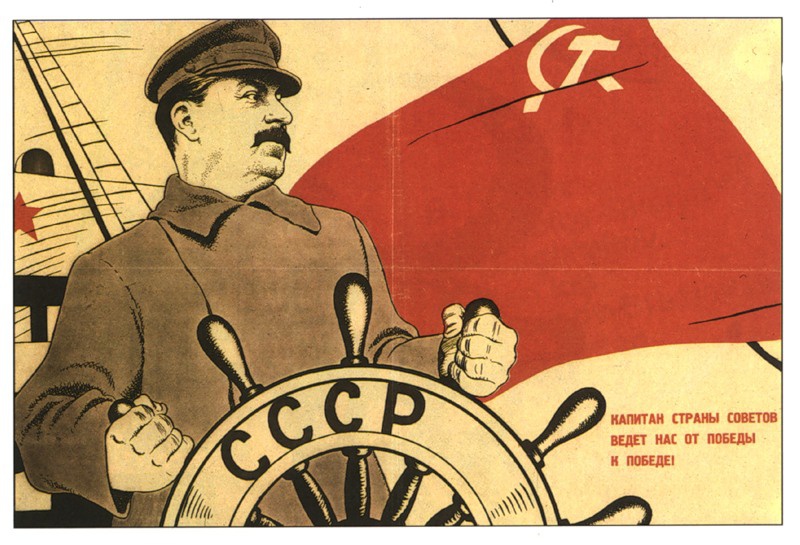
Historical policy toward Stalin is a very special case. This is because it is related not to any particular event or period in history but to a historical figure whose image is not integral (it would be more correct to speak about multiple images of Stalin). In most cases – this is more common for CPRF – the image of Stalin turns into a sort of simulacrum. This happens because it refers the reader not to Stalin, be it a seemingly real personality, but to the artistic and ideological tradition that has been built around Stalin over the past years.
There are many “Stalinist” topics in the toolkits of UR and CPRF. “Stalin and the war,” “Stalin and repressions,” “Stalin and the ‘de-Stalinization project’,” “Stalin and elections to the State Duma” (or: “Stalin and the fight against corruption”). We will look at some of them.
4.1. Stalin and the War
Stalin’s role in the war defies any straightforward assessment, and many UR members agree with this. The appearance of Stalin in the context of celebrating the victory in the Great Patriotic War is one of the dramatic and debatable issues of historical policy. In the situation which is outside the timeframe of this monitoring but anteceded the 2011 debates, i.e. the Luzhkov government’s attempts to put up billboards with the portrait of Stalin in May 2010, the problem was stated in a fairly detailed way: whether Commander-in-Chief Stalin can be the symbol of Victory. If the Victory is not “deconsecrated,” if the dark aspects are not talked about, and if the image of Stalin is closely linked with it, this means that Stalin will receive a pardon for all crimes that he had committed.
The “Commander-in-Chief Stalin” situation is further compounded by the soviet historical tradition (and a succeeding post-soviet one) with respect to “historical truth”: politicians are sure that the statement “victory in a war cannot be celebrated without the person who led this war” is historical truth. Historian Nikolai Koposov analyzes this situation in his book. He comes to a conclusion that a whole layer of academic disputes about the Great Patriotic War has been forcibly deleted from the Russian political culture. Debates about the war and Stalin’s role in it are ousted to the periphery, and rhetoric of UR and CPRF abounds in “obvious historical truths” similar to the abovementioned one.
Although the image of Stalin-the-War-Winner was not replicated on the mass scale after all, the idea of Stalin as a symbol of the war was not rejected. For example, “Stalin buses” (buses and minibus taxis bearing Stalin’s portraits) and banners appeared in Omsk [historypolitics], Togliatti and Samara [historypolitics] under the pressure of CPRF. Governments of these cities and oblasts are made of the UR members but they did not discourage the communists’ “pro-Stalinist” ideas.
CPRF presents attempts to put up monuments and busts to Stalin in several cities (Barnaul, Penza [historypolitics] and Belgorod) as an “initiative of the war veterans.” The war veterans are immune from any criticisms within the official rhetoric because they represent “the moment of truth” which is scarcely questioned by the public and their heroic past (sometimes ostensible) is perceived as sacred.
4.2. Stalin and “De-Stalinization”
The image of Stalin is presented in an entirely different light in the context of the two parties’ debates with “de-Stalinizers,” i.e. the authors of the draft national program “On Honoring the Memory of Victims of Totalitarian Regime and National Reconciliation.” The program was presented by the Presidential Council on Human Rights in February 2011. The UR members are less scathing in their assessment of the initiative which is offered by the drafters (or the one which is ascribed to them). Yet, as CPRF [historypolitics], they view this program as “useless” at best and “harmful” and “dangerous” at worst.
Opponents of “de-Stalinizers” automatically equal the acknowledgement of Stalin’s crimes with treason of the entire soviet past. For example, CPRF uses “de-Stalinization” and “de-sovietization” as interchangeable concepts. But the parties are not ready to assume such risks (criticism of the entire soviet past) with respect of Stalin and “Stalinist” historical topics. Both CPRF and the United Russia avoid debates about the Molotov-Ribbentrop Pact. They say these “harmful” discussions equate the USSR with the Nazi Germany, and victory in the Great Patriotic War is tarnished.
Both parties bring another charge against “de-Stalinizers”: allegedly, de-Stalinizers simply try to distract the public from the hot topics of the day by diverting the public attention to what Zyuganov called “cave-age anticommunism.” The communists believe that the following topics are much more important than the need to overcome the Stalinist legacy in the Russian society: “military isolation of Russia and its mousetrapping by NATO; the West’s attempts to undermine the state structure of the Russian Federation by staging the “colored” revolutions in the neighboring countries: and history of the Great Patriotic War as an example of our nation’s unity against aggression from the West” [historypolitics].
4.3. Stalin and Repressions
Neither communists nor the United Russia members initiate a public discussion of Stalin’s role in the repressions of the 1930-1950ies. The United Russia was reluctant to take part in the ceremony of opening a monument in Barnaul [historypolitics] and in reburials of victims of the Great Terror [historypolitics], and participated only because these were official ceremonies. Thus, its members attended as representatives of the city and oblast governments in Barnaul. At the same time, though, after President Medvedev’s statements on October 30 (the day when the memory of victims of political repressions is honored) they made rather explicit utterances about events of the 1930-1950ies and their criminal nature.
While assessing Stalin’s policy in the 1930-1950ies, CPRF members do not talk about Stalin as the criminal who is guilty of mass-scale repression. Instead, they speak about the leader of nations who was busy with the prosperity of the soviet state, on the one hand, while on the other hand he was in the shadow of his aides who were allegedly much crueler hangmen than he.
This is what answers CPRF gives to questions about Stalinist repressions:
-
Who is guilty of repressions besides the “men on top”? – “Local bad guys”: “It was not only out of fear that people reported on each other – they were often driven by envy, personal gain and other dark instincts. The repressions were accompanied by large-scale and petty intrigues related to the struggle for job positions.
Zyuganov. Ibid., p. 15. ” -
Who were people that fell victims to the state terror? – “Enemies” and “companions”: “With all its tragically contradictory nature, year ‘thirty seven swept from the political arena, in the first place, those who had hung on the great popular revolution, as Lenin put it.
Ibid., p. 15. ” -
What was the magnitude of repressions? – “The costs of collectivization in the USSR are quite comparable to enclosures in England, i.e. illegal seizure of peasants’ lands,” contends Zyuganov
Ibid., p. 25. .
By giving these answers to questions, CPRF ideologues have no need to join those who condemn Stalinist repressions. On the contrary, they can even compliment Stalin on his “sagacious” liquidation of the “fifth column” which could have played the fatal role in the Great Patriotic War (MGU scholars Vdovin and Barsenkov write about this in their textbook
It is not by chance that the pre-election Stalin becomes the true brand of CPRF. He looks from the communists’ election posters in Samara and Togliatti, promising effective solutions of the current problems to voters: “Corruption? Haven’t heard of any.” Yet, a CPRF member and State Duma deputy Leonid Kalashnikov chooses to make a reservation: “Of course, it is not the question of shootings. This is not propaganda of Stalinism” [historypolitics]. The doubtful double meaning is there, though. This is probably the reason why the CPRF’s banners where Lenin and Stalin look at voters from behind Zyuganov are being quickly torn down in Moscow [historypolitics].
CPRF has effectively privatized the image of Stalin and, by doing so it denies other parties’ right to use this “trademark.” When another party attempted to use the image of Stalin in its interests (members of Fair Russia did this when they registered a person whose name was Stalin as their candidate for election), communists demonstrated strong resentment [historypolitics] and expressed hope that this “fake candidate” would be removed from the ballots.
5. Lenin and Heroes of the Soviet Pantheon
Historical initiatives of the parties often come to be related to certain figures of the soviet past, usually on the occasion of the respective memorable dates. The United Russia and CPRF often differ dramatically in their assessments of these figures and dispute about them. At other times these figures remain in the periphery of the public attention and outside the present-day political context. In these circumstances the United Russia can afford to speak very critically about some forgotten soviet “heroes” or ignore them altogether, thus earning the sympathy of voters including those who take the anti-soviet (critical) position.
5.1. Lenin
Lenin has largely lost his political and ideological weight despite the Mausoleum in Red Square. CPRF does not organize any particular events that would commemorate Lenin (it would be absurd to call for new monuments to Lenin because it is not clear where the old ones should be stored). In turn, the United Russia launched website goodbyelenin.ru [historypolitics] on the next anniversary of Lenin’s death. Members of the ruling party say that the results of the website voting show that the society is ready to see the body of Lenin removed from the Mausoleum. The continued inaction, however, demonstrates the reverse side of this phenomenon: despite the constitutional majority in the Duma and almost 100% representation in the Cabinet, the United Russia does not take any ideological decisions that might cause political damage to it as a party. In the case of Lenin, the party does not go beyond expressing its opinion
5.2. The Tambov Rebellion (1920-1921)
The abovementioned United Russia member Vladimir Medinsky flared at CPRF unexpectedly on the anniversary of the Antonov Rebellion [historypolitics]. He said that the killing of rural population of the country and the crushing of the peasant revolt by the troops under command of Tukhachevsky was a “crime against humanity.” Medinsky disputes with CPRF and reasonably draws attention to the communists’ paradoxical behavior: CPRF defends Tukhachevsky whom their other hero, Stalin, shot in 1937. This is an example of the rickety nature of the historical framework to which the present-day CPRF turns. It would be enough to consistently turn to the most common historical facts in order to discredit it. This does not happen, though, because both parties, with their current convoluted understanding of the “unpredictable past,” need each other.
5.3. Voikov
Medinsky’s other initiative – an attempt to press for re-naming Voikovskaya metro station [historypolitics] that had been named in honor of the person who organized the murder of Russia’s imperial family – is equally remarkable and equally fruitless. However, Zyuganov says in his book “Stalin and Modern Age” that communists did not kill the royal family
5.4. Kirov
The 125th anniversary of Sergei Kirov [historypolitics] who was not the least important person in the communist pantheon paled into insignificance and passed without any attention of the authorities.
5.5. Gagarin
Yuri Gagarin stands aside from the purely political figures in the 2011 monitoring. The authorities’ numerous initiatives related to the 50th anniversary of the first space flight do not have any marked political overtone. Conferences, monuments, festivals and competitions picture Gagarin as a courageous hero whose flight crowned the achievements of the national science. The emphasis is on “national” and not on “soviet” because those who organized the official in-memoriam events did not focus on the origin of the space project. CPRF is eager to explain what Motherland Gagarin had: the party accused the power-holders of intentionally deleting the “USSR” letters from Gagarin’s space helmet on the festival photos [historypolitics]. Yet, a close look into this issue showed that Gagarin made his space flight in a space helmet which did not bear any acronym letters.
6. A Different “Modern Age” and a Different “History”
The last section of our review will focus on several historical topics that vividly demonstrate parties’ very special style, context and methods of public activity in the field of historical policy.
6.1. “Front” and “Volunteer Corps”
As Prime Minister Vladimir Putin said, the parties and public movements that borrowed his idea of the “Popular Front” (which appeals to the soviet idea of the front and mobilization) are “copycats.
6.2. Yeltsin and the 1990s
The historical role of Boris Yeltsin and events of 1991 are topics that are used in the historical politics of 2011 because the first Russian President would have celebrated his 80th birthday in 2011, August 2011 will mark 20 years since the putsch, and Belovezhsky agreements were signed 20 years ago in December.
The authorities’ official position toward Yeltsin during the celebration of his first postmortem anniversary was very loyal as compared to what was said about the Yeltsin epoch before, in the second half of the 1990s: “I think present-day Russia should be grateful to President Yeltsin for the fact that, in our most difficult period, we did not sway from the path of change but it managed to perform very difficult transformations and it continues moving forward today” (Dmitry Medvedev) [historypolitics]; “He led the process of radical changes that brought Russia from the stalemate in which it found itself,” “We now understand that Russia experienced a second birth in the 1990s. It became an open state” (Vladimir Putin”) [historypolitics].
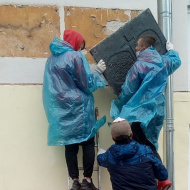
All the more radical was the position of CPRF which publicly criticized the opening of a monument to Yeltsin in Yekaterinburg. Furthermore, it made an “alternative” commemorative plaque on which it listed all his “crimes” against his nation, and put it on the house in which he had lived [historypolitics].
The coming anniversary of 1991 is so far not commented by the United Russia members (some statements might be expected in August). CPRF posted an appeal letter on its website. Written by Oleg Yurin, a “Russian scientist from Oxford,” this letter called on all those who are on the same wavelength to turn off lights in their apartments on December 8:
“We raise the voice of conscience. From now on, the sorrow of “December 8, 1991” should be kept in our soul. The ashes of our suffering forefathers knock at our hearts. This is not for some period but FOR EVER. This shame must be washed off and be remembered by the future generations” [historypolitics].
6.3. The War of 1812
The proposal to put up a new monument to General Yermolov stands out among numerous initiatives of the authorities and the United Russia Party on how to celebrate the War of 1812 [historypolitics]. There is a more forward-looking plan to canonize General Yermolov [historypolitics]. This latter initiative looks dubious, given that few people remember about Yermolov’s heroism in 1812 but many more Russians (particularly those who live in the Northern Caucasus) are perfectly aware of his role in the Caucasian Wars in the 19th century.
6.4. Karl Marx and Catherine II
A very rare “intrusion” of CPRF in the history outside the 20th century which happened in the town called Marx (Saratov oblast) is worthy of special reference because it illustrates historical polemics between political forces.
The local public movement Lyubimy Gorod [“The Town I Love”] wants the town to have its old name Yekaterinenschtadt back, while the local CPRF group opposes this:
“For the sake of our country Catherine II changed her name, learned our language, accepted our faith, came to love our country and devoted her whole life to the expansion of borders and development of scientific and cultural activities,” says Lyubimy Gorod. And Karl Marx “had never been to Russia. He was an ethnic Jew who became Catholic and later renounced religion altogether. It is because of his “ideological thoughts” that churches were damaged and destroyed across our country. It was he who abandoned his child and did not even go to his father’s funeral ceremony. This “great economist” was unable to earn money even for a pack of cigarettes and always failed on a stock exchange. This scientist fed on his wife all his life. This was a philosopher who drank a lot and kicked up rows.”
“Along with the positive deeds, many actions of Empress Catherine II deserve mixed assessment. Take, for example, her disfavor of Mikhail Lomonosov, Alexander Suvorov, Fyodor Ushakov and other great countrymen who were our national heroes and brought fame to Russia in science and military field, and whom we all are proud of. Or, take the merciless suppression of the peasant uprising when people of many ethnic origins were killed – their graves are wept off the Russian land,” say the communists as they call for a town-wide referendum on the name of the town. Conversely, Marx is a great thinker – scientist, economist and philosopher, and “one of the few people whose ideas and writings influenced the path of civilization on the planetary scale” [historypolitics].
Perhaps all these examples reveal, as Alexey Miller put it, the traces of “destruction of an environment for a public dialogue on the problems of history
***
Real cooperation of various parties and movements in the field of “historical policy” implies certain experience of public policy in the country, as well as public experience of working with history. Both experiences are of a very specific nature in Russia.
There is a commonplace statement that the Russian ruling party does not have its own consistent ideology (a system of ideas) and, accordingly, lacks such a holistic idea of history that is based on certain unchangeable political values which this party could have advocated.
On the other hand, history as a social science in Russia has not yet recovered from the highly traumatic existence in the totalitarian (and later authoritarian) Soviet Union. Today, there a much too wide gap between what the academic history is and whet perceptions the public and political elite have about history. The result was (and still is) a “gap between the practices of history research and re-creation of the national mythology, and this gap is very difficult to bridge”
While we agree with Nikolai Koposov in that “the Russian political parties are usually not backed by any well-established ‘historical cultures’ ”
Despite all its real or imaginary efforts to become “a modern left-wing party of a European type,” CPRF remains an “old-timey” and a true successor to the CPSU. It defends the mythological image of the soviet past which is turning into a Utopia as time goes by.
Bibliography
- А. Miller. Rossia: vlast i istoria [Russia: Power-Holders and History] // Pro et Contra, May-August 2009
- А. Zorin. Zapreschat obsuzhdat pobedy – znachit priravnivat ee k porazheniyu [Ban on discussions of victory means treating it as a defeat]
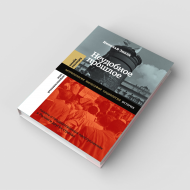
- N. Koposov. Pamyat strogogo rezhima: istoria i politika Rossii [Strict-security memory: history and politics in Russia]. М., 2011.
- B. Dubin. Pamyat. Voina/ Pamyat o voine. Konstruirovanie proshlogo v sotsialnoi praktike poslednikh desyatiletii [Memory .War. Memory about War. The Formation of the Past in the Social Practices of Recent Decades].
- D. Louental. Proshloye – chuzhaya strana [The past is a foreign country]. St. Petersburg, 2004.
This review was made by: Sergei Bondarenko, Irina Scherbakova, Yulia Chernikova